

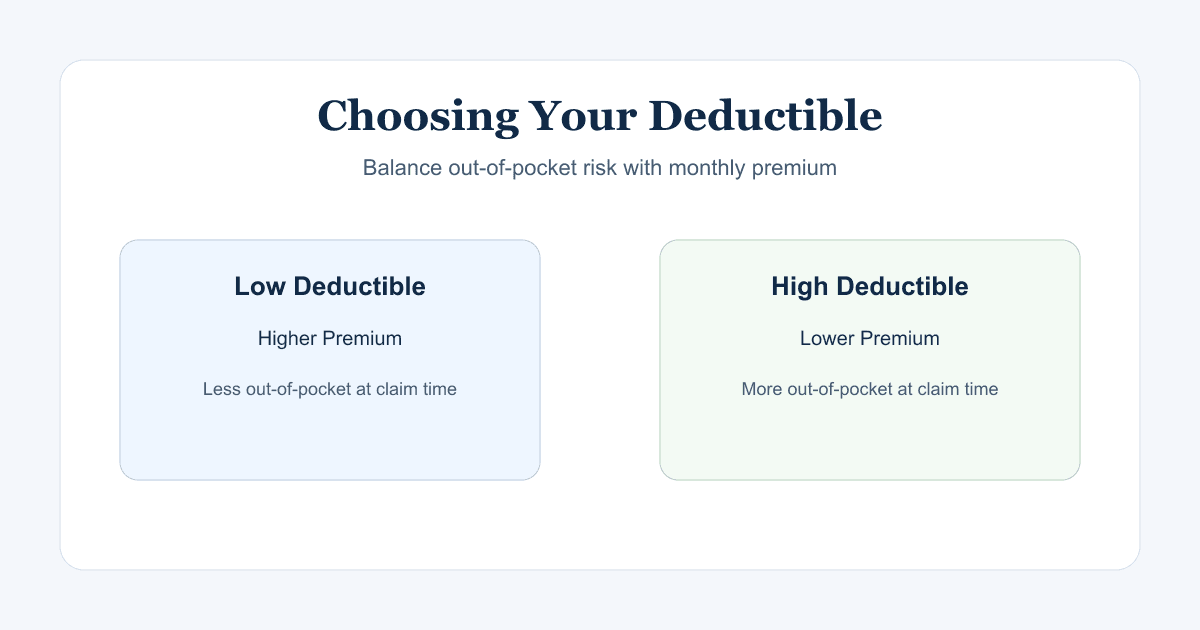
At Redman Insurance, we are passionate about helping you find the right balance between your deductible and your premium.
A higher deductible can lower your premium, but make sure you can afford it in case of a claim. Find the right balance for your budget!
A deductible is the amount you pay out of pocket on a covered claim before your insurance kicks in. Choosing the right deductible is really about balancing risk and cost. When you select your deductible you're deciding how much risk you're comfortable covering yourself versus paying your insurer to take on.
Start with the only question that matters: “Could I write this check tomorrow?”
Before you compare premium quotes, set a hard affordability cap based on liquid cash (not credit). For many households, a practical ceiling is keeping your deductible less than or equal to your liquid emergency funds (ideally funds you can access within 24-72 hours).
Stress-test this: could you pay the deductible and handle your next month of fixed expenses if the loss disrupts work or creates other costs? This avoids the most common failure mode of insurance: saving on premium but being forced to delay repairs or take on high-interest debt after a claim.
The Redman Break-Even Test
When you increase your deductible, you usually reduce your premium. The trade-off is measurable. To figure out if it makes sense, we use the Redman Break-Even Test to calculate your break-even claim frequency:
If you believe your probability of a deductible-triggering claim in a year is below this number, the higher deductible may be more cost-effective over time; if it’s above, the lower deductible might be the safer choice.
Real-World Auto Example: Let's say you are considering raising your auto collision deductible from $500 to $1,000 (an increase of $500). If doing this saves you $120 a year in premium, the math looks like this:
If you expect a collision claim more often than roughly once every 4 years (a 24% chance), the higher deductible becomes less attractive.
Think in “Expected Out-of-Pocket” Cost
Another way to compare your options is to estimate your expected annual cost. While intentionally simplified, it forces a more rational comparison than simply picking the cheapest monthly rate:
Practical Benchmarks for Idaho Residents
There isn’t one universal ratio for choosing a deductible, but here are practical targets you can adjust using the Redman Break-Even Test:
Auto Insurance
We generally recommend considering the highest deductible you could comfortably pay from liquid savings without going into debt. Many drivers benchmark this to 1 to 2 weeks of take-home pay. Strategy tip: Don't automatically set collision and comprehensive deductibles at the same amount. If you live in an area of Idaho prone to animal strikes or hail, keeping your comprehensive deductible lower while raising your collision deductible is often a smart play.
Homeowners Insurance
If your policy uses a percentage deductible for certain types of losses, make sure you understand what that percentage equals in actual dollars. For example, if your home is insured for $450,000 and your policy has a 1% deductible for a particular type of loss, your deductible would be $4,500. It’s important to make sure that amount would be financially manageable if a claim happened.
Line-by-line strategies (where deductible choices differ)
Health insurance: optimize around cash flow, not just “best plan”
Health plans often combine deductible + coinsurance until you hit the out-of-pocket maximum.
Strategy: compare plans using two scenarios: first, a typical year (routine care, a few scripts) and second, a high-cost year - think major life events and hospitalization. Your decision should be acceptable in both.
HSA/HDHP strategy: if you choose a high-deductible health plan, the deductible can be more manageable when paired with an HSA contribution plan that “pre-funds” the deductible using tax-advantaged dollars.
Quick mistake to avoid
Choosing a higher deductible without explicitly earmarking cash for it. If you “save” $15/month but don’t reserve it, you haven’t actually improved your risk position - you’ve just increased the chance of financial strain after a loss.
Bottom line
Choose a deductible you can comfortably afford if you need to file a claim. Once you know what fits your budget, compare premiums to see if the savings are worth taking on more out-of-pocket risk. The goal is to lower your insurance costs without putting yourself in a financial bind when you need coverage the most.
The 15-Minute Deductible Checklist
- List your deductible options (and any special/percentage deductibles).
- Set your maximum affordable deductible based on liquid reserves.
- Compute premium savings for each step up in deductible (annualized).
- Run the Redman Break-Even Test by dividing your premium savings by your deductible increase.
- Reality-check your claim likelihood using your personal history and local risks (miles driven, Idaho weather exposure, etc.).
- Pick the deductible that you can comfortably pay tomorrow and offers meaningful premium efficiency.
Not sure where your deductible should land? Get a free quote, and we’ll run your policy both ways and show you the real cost difference.
Get a free quoteAlready have coverage? Talk to a Redman Insurance agent about reviewing your current deductibles before your next renewal.
Talk to a Redman Insurance agentCoverage, limits, deductibles, eligibility, discounts, and pricing vary by carrier and policy. This information is for general educational purposes only and does not modify, replace, or guarantee the terms or coverage provided by any insurance policy.