

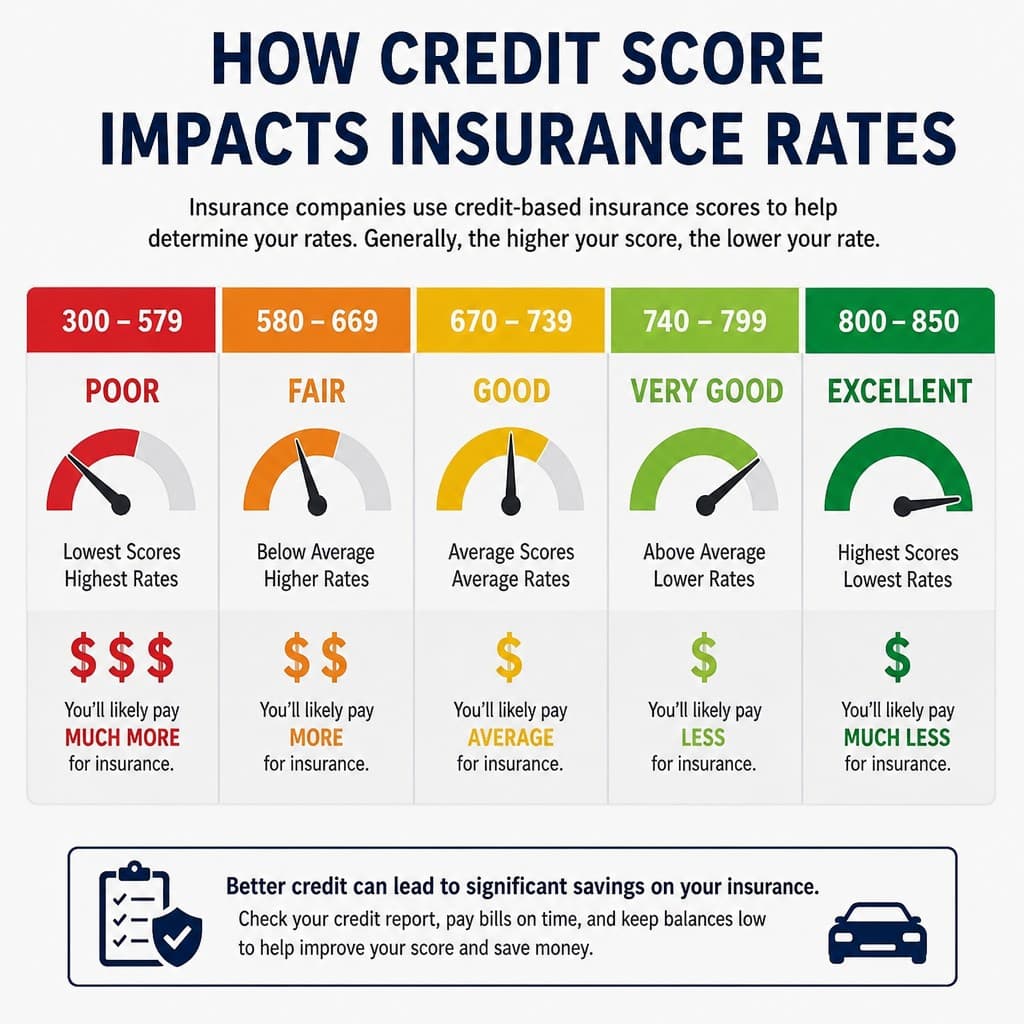
Redman Insurance provides thorough assistance in finding you highly competitive rates and tailored coverage across a variety of carriers. However, we are also passionate about ensuring our customers know how to secure the best rates in the long run. One commonly-overlooked factor behind your monthly premium is often your credit profile.
Your credit score can affect more than borrowing. In many U.S. states (including Idaho), insurers may use credit information when pricing certain policies - meaning two people with the same driving record or the same home can still be quoted different premiums.
This article explains which types of insurance are most impacted, what’s true (specifically in Idaho), how common credit-based pricing is, what kind of savings (or extra cost) you might see, why insurers use it, and practical ways to improve your credit over time.
First: The metric may not exactly be your “credit score”
Most insurers don’t plug in the same credit score you see in a banking app. Instead, they often use a credit-based insurance score (sometimes called an insurance score). It’s built from credit report data (payment history, outstanding debt, length of credit history, new credit, etc.), but it’s designed to predict insurance loss risk, not loan default risk. The inputs overlap with a typical credit score; the model and purpose are different.
Are we only talking about auto insurance?
No. Credit-based insurance scoring is most associated with personal auto insurance, but it can be used in other lines too.
Personal insurance types where credit is most commonly used
- Personal auto
- Homeowners
- Renters
- Condo
- Umbrella
Insurance types where credit is typically not used (or is less directly tied to price)
- Health insurance
- Life insurance
- Disability insurance
What about business insurance?
For commercial coverage, the story is more nuanced. Many commercial policies don’t use a personal credit-based insurance score the same way personal lines do, but carriers may still consider business financial stability signals (for example, time in business, payment history, prior cancellations, collections, or in some cases business credit data) depending on the product and carrier.
- Commercial auto: some carriers may consider credit-related information; practices vary
- BOP / commercial property / general liability: underwriting often focuses on operations, claims, location, and financial stability; credit-related data may be used by some carriers
- Workers’ compensation: typically driven by payroll, class codes, and loss experience more than credit
Idaho: Is credit used in insurance pricing here?
In Idaho, credit-based insurance scoring is generally permitted for many personal policies (like auto and homeowners), and it’s common for carriers to factor it in as part of their overall rating plan. The exact impact varies by insurer, product, and customer profile.
Even where allowed, credit information is typically treated as one factor among many (alongside driving history, claims, location, vehicle/home characteristics, coverage limits, deductibles, and discounts). If you’re shopping in Idaho and want to know whether credit will be used, you can ask the agent or insurer directly before they pull a report.
What kind of savings are we talking about?
The effect can be meaningful because credit-based insurance scoring may shift you into a more (or less) favorable rating tier. The exact numbers depend on insurer, state rules, and the rest of your profile.
Some estimates suggest that auto insurance faces the most severe percentage penalty for bad credit, with average annual premiums surging by 273% (from $1,673 for "exceptional" credit to $6,254 for "very poor" credit) according to a 2025 analysis of 83 million rates by The Zebra. Renters insurance follows closely, seeing a 215% increase (jumping from $153 for "excellent" credit to $483 for "poor" credit) based on 2026 rate data compiled by MoneyGeek. By comparison, homeowners insurance generally experiences a proportionally smaller penalty - an approximately 100% increase, as detailed in an August 2025 joint report by the Consumer Federation of America - because the physical risk of the structure itself absorbs much more of the pricing weight than the policyholder's personal credit history. These figures are national examples for illustration; they are not Idaho quotes and will not match every carrier or household.
Why insurers use credit for credit risk assessment
Insurers may use credit-based insurance scores because historical data has shown a statistical relationship between certain credit characteristics and insurance claim frequency or severity. This does not mean that poor credit causes claims; it is simply one of many rating factors an insurer may consider.
A 2007 FTC report to Congress concluded that “Credit-based insurance scores are effective predictors of risk under automobile policies. They are predictive of the number of claims consumers file and the total cost of those claims.”
Where credit can’t be used (and why that matters)
Rules vary by state. A few states restrict or prohibit using credit information in certain P&C insurance pricing (commonly cited examples include California, Hawaii, and Massachusetts). If you move out of Idaho, the role of credit in your insurance quotes may change even if nothing else does.
What if you’re penalized due to credit?
- Ask what drove the price: insurers can often tell you which broad factors affected your quote
- Shop around: carriers weigh credit differently, and some rely on it less
- Adjust levers you control: higher deductibles, bundling, defensive driving discounts, or policy review can sometimes offset credit-related pricing
Tips to improve your credit score (and potentially reduce insurance costs)
Better credit doesn’t guarantee a lower premium with every insurer, but it can improve your odds - especially in lines like auto and homeowners where credit-based scoring is common.
- Pay on time: payment history is a major driver of credit scoring models
- Lower utilization: aim to keep revolving balances well below your limits
- Reduce high-interest debt: it helps utilization and overall financial stability
- Limit hard inquiries: avoid applying for multiple new accounts in a short period
- Check your credit reports: dispute errors and outdated negative items where appropriate
- Keep older accounts open (when sensible): age of credit history can help
Key takeaways
- In Idaho, credit-based insurance scoring is generally allowed for personal policies and is commonly used in auto and homeowners pricing.
- It’s not just auto: homeowners, renters, and condo insurance can also be affected; commercial lines vary by insurer and product.
- The impact of credit-based insurance scoring varies by carrier, policy type, and individual rating profile.
Want to see how your Idaho rates compare? Get a free quote, and we’ll shop multiple carriers for you.
Get a free quoteAlready insured? Talk to a Redman Insurance agent about reviewing your current policies and shopping options.
Talk to a Redman Insurance agentCoverage, limits, deductibles, eligibility, discounts, and pricing vary by carrier and policy. This information is for general educational purposes only and does not modify, replace, or guarantee the terms or coverage provided by any insurance policy.