Summer is one of the busiest driving seasons of the year in North Idaho. With road trips, weekend getaways to the lake, and an influx of seasonal drivers on the road, it is the perfect time to take a fresh look at your auto insurance. Wildlife collisions happen year-round here too, and they peak in October through December, so this checklist is worth doing even after summer travel ends.
Before you hit the road, it is crucial to understand what your coverage actually does, and where your financial gaps might be. As your local advisors at Redman & Company Insurance, we have put together The Redman Road-Trip Readiness Check, breaking down the five specific coverages you need to understand before driving this season.
1. Comprehensive Coverage: Protection Beyond a Collision
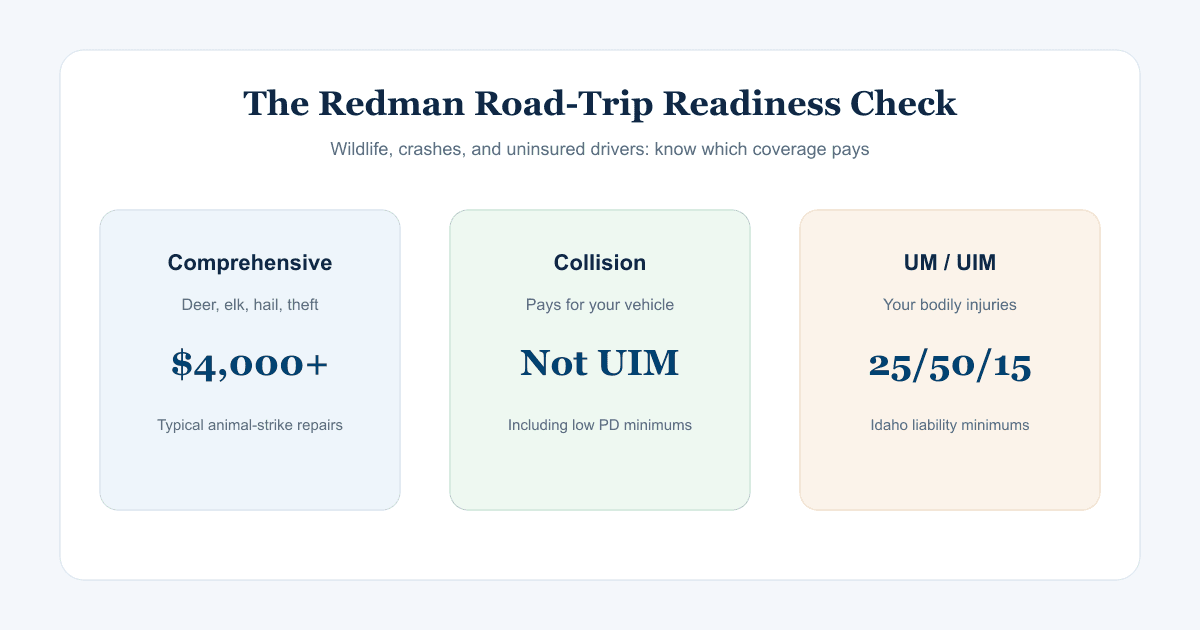
Despite its name, comprehensive coverage doesn’t cover every possible situation. Instead, it generally protects your vehicle from damage caused by things other than colliding with another car. Covered situations typically include theft, vandalism, hail, falling objects, and hitting an animal.
The Idaho Reality Check
Wildlife collisions are a major hazard in our state. A 2008 Federal Highway Administration study estimated the average cost of repairing a vehicle after colliding with a deer at $1,840. That figure is outdated.
Animal strikes can cause significant damage, especially with today’s vehicle technology and repair costs. A collision with a larger animal, such as an elk on Highway 95, can result in extensive damage or even a total loss. If you carry liability coverage only and do not have comprehensive coverage, damage to your own vehicle from an animal strike would generally not be covered by your auto policy.
According to an analysis of national auto insurance claims by Texas-based Aulsbrook Car & Truck Wreck Injury Lawyers, the average animal collision claim is now just over $5,000.
State Farm data shows October, November, and December accounted for about 41% of animal-collision claims in its latest study period, so this coverage matters well beyond summer lake season.
2. Collision Coverage: When Your Vehicle Hits Something
Collision coverage helps pay for damage to your vehicle when it is involved in a covered crash, regardless of who is at fault. That could mean hitting another vehicle, striking a guardrail, or having a single-vehicle accident.
The Idaho Reality Check
If you accidentally back into a pole or a heavy timber post while parking your RV at Farragut State Park, collision coverage is what pays to repair your tailgate and bumper, subject to your deductible.
Collision coverage may also help if another driver damages your vehicle. Idaho requires only $15,000 in property damage liability coverage, which may not be enough to cover significant damage to a newer truck or SUV. If the at-fault driver’s property damage limit is exhausted, your own collision coverage may help pay to repair or replace your vehicle, subject to your deductible, the vehicle’s value, and the terms of your policy. Idaho UM/UIM bodily injury coverage is designed to protect against injury-related losses and is not a substitute for collision coverage on your vehicle.
3. Roadside Assistance: Help When You’re Stranded
Even a well-maintained vehicle can experience problems. A dead battery, a flat tire on a dirt road, or a mechanical breakdown can quickly turn a summer road trip into an expensive delay.
The Idaho Reality Check
A private tow can become expensive quickly, easily ranging from $100-$250 on a low estimate, especially if you are stranded outside of town or need to be transported a significant distance. Before heading out, check whether your policy includes towing only or additional services such as jump-starts, fuel delivery, tire assistance, and lockout service. Coverage and limits vary by carrier.
4. Uninsured / Underinsured Motorist Coverage (UM/UIM)
Unfortunately, not every driver on the road carries adequate insurance. Uninsured motorist coverage protects you financially if an at-fault driver has no auto insurance. Underinsured motorist coverage kicks in when the at-fault driver has insurance, but not enough to cover your injury-related costs, such as medical bills and lost wages. In Idaho, UM/UIM is primarily bodily injury coverage. It is not a substitute for collision coverage on your vehicle.
The Idaho Reality Check
The Insurance Information Institute, citing Insurance Research Council estimates, reported that 6.2% of Idaho drivers were uninsured in 2022.
Idaho’s mandatory minimum liability limits are $25,000 for bodily injury per person, $50,000 per accident, and $15,000 for property damage (often written as 25/50/15). If an at-fault driver only carries $25,000 in bodily injury coverage per person and your medical bills, lost wages, and other injury damages exceed that, UIM is what can help close the gap. Insurers must offer UM/UIM unless you reject it in writing. Before rejecting UM or UIM coverage, make sure you understand the protection you are giving up and talk with your agent about how the coverage could respond if you or your passengers are injured by an uninsured or underinsured driver.
5. Rental Reimbursement: Keep Moving After a Claim
What happens if your vehicle is damaged in a covered accident and needs to spend three weeks in the local auto body shop? Rental reimbursement coverage helps pay for a rental vehicle while your car is being repaired, subject to your policy's daily limits.
The Idaho Reality Check
Rental costs can add up quickly when repairs take several days or weeks. Rental reimbursement coverage can help with that expense when your vehicle is being repaired after a covered loss, subject to the daily and total limits shown on your policy. Rental reimbursement generally does not apply to routine mechanical breakdowns.
Frequently Asked Questions (Idaho Auto Coverage)
What is the minimum auto insurance required in Idaho?
Idaho law requires drivers to carry a minimum of $25,000 in bodily injury liability per person, $50,000 in bodily injury liability per accident, and $15,000 in property damage liability (often written as 25/50/15).
Does comprehensive insurance cover hitting a deer in Idaho?
Generally, yes, if you carry comprehensive coverage. Direct contact with a deer, elk, moose, or other animal is typically handled under the comprehensive portion of an auto policy, subject to your deductible and policy terms. If you swerve to avoid an animal and strike another vehicle or object instead, the claim may be handled differently.
What happens if an uninsured driver hits me in Idaho?
If you are hit by an uninsured driver, Uninsured Motorist (UM) bodily injury coverage may help pay for covered injury-related damages. It generally does not pay for damage to your vehicle. Vehicle damage may instead be addressed through your collision coverage, if purchased, subject to your deductible and policy terms. Without UM bodily injury coverage, your available options for recovering injury-related damages may be more limited.
Is towing included in standard auto insurance?
Not automatically. Roadside assistance and towing are usually optional add-ons (endorsements) that must be specifically selected on your policy.
Key Takeaways
- State minimums may not be enough: Idaho requires only $15,000 in property damage liability coverage, which can fall short when a newer or higher-value vehicle is seriously damaged.
- Review your wildlife protection: Animal strikes are a real concern for Idaho drivers. Comprehensive coverage generally provides protection for direct collisions with animals, subject to your deductible and policy terms.
- UM/UIM protects people, not the truck: Idaho UM/UIM bodily injury coverage is designed to help with covered injury-related damages when an at-fault driver has no insurance or not enough insurance. It should not be relied on as a replacement for collision coverage on your vehicle.
- Prepare for the unexpected: Adding optional coverages like roadside assistance and rental reimbursement is usually a small premium increase compared with a private tow or rental fees during a multi-week repair. Coverage and limits vary by carrier.
Drive safely, plan ahead, and enjoy the journey this season.
Take Action Today
Take a few minutes today to ensure your policy is keeping up with your needs.
Get a free quote, and we’ll review your current coverage, deductibles, and available options for additional protection.
Get a free quoteTalk to a Redman Insurance agent to walk through comprehensive, collision, UM/UIM, roadside, and rental reimbursement on your policy.
Talk to a Redman Insurance agentCoverage, limits, deductibles, eligibility, discounts, and pricing vary by carrier and policy. This information is for general educational purposes only and does not modify, replace, or guarantee the terms or coverage provided by any insurance policy.